
Most enterprises already know who has privileged access. The harder question is whether that access still makes sense.
An engineer receives temporary elevated permissions during an infrastructure migration and keeps them for two years. A vendor account stays active because nobody wants to risk breaking an integration. Internal admins slowly accumulate overlapping privileges across systems managed by different teams. Eventually, the organization reaches a point where access technically works, but nobody fully understands how exposed the environment actually became.
This is exactly why enterprise access security became far more operational than technical. The challenge is no longer simply storing credentials securely. Security teams now need visibility into permissions, session behavior, privilege escalation, remote access activity, and identity-related risks happening across environments that constantly evolve underneath the business.
That pressure changed the PAM market significantly.
The vendors getting the most enterprise attention now are usually the ones helping organizations reduce uncertainty around privileged activity itself. Session transparency, governance visibility, behavioral analytics, remote access oversight, and identity-aware monitoring became much more central than static password management alone.
Here are five PAM vendor organizations that are frequently evaluated when rebuilding enterprise access security strategies around visibility and operational control.
1. BeyondTrust
BeyondTrust focuses heavily on reducing privilege exposure across enterprise environments rather than only controlling credentials themselves.
That distinction matters because excessive access often becomes one of the biggest long-term security risks inside large organizations.
Administrative permissions expand gradually. Temporary access becomes permanent. Remote workflows create additional exceptions. Eventually, security teams lose clear visibility into how broad privileged exposure actually became across the environment.
BeyondTrust addresses this through centralized privilege management and operational oversight.
Capabilities include:
- Privileged remote access
- Endpoint privilege management
- Session monitoring
- Credential management
- Vendor access security
- Least privilege enforcement
The platform is especially relevant for enterprises managing distributed administrative teams and remote infrastructure workflows where privilege sprawl becomes difficult to control consistently.
BeyondTrust also places strong emphasis on endpoint visibility and remote access governance, helping organizations tighten administrative exposure across hybrid environments.
2. Syteca
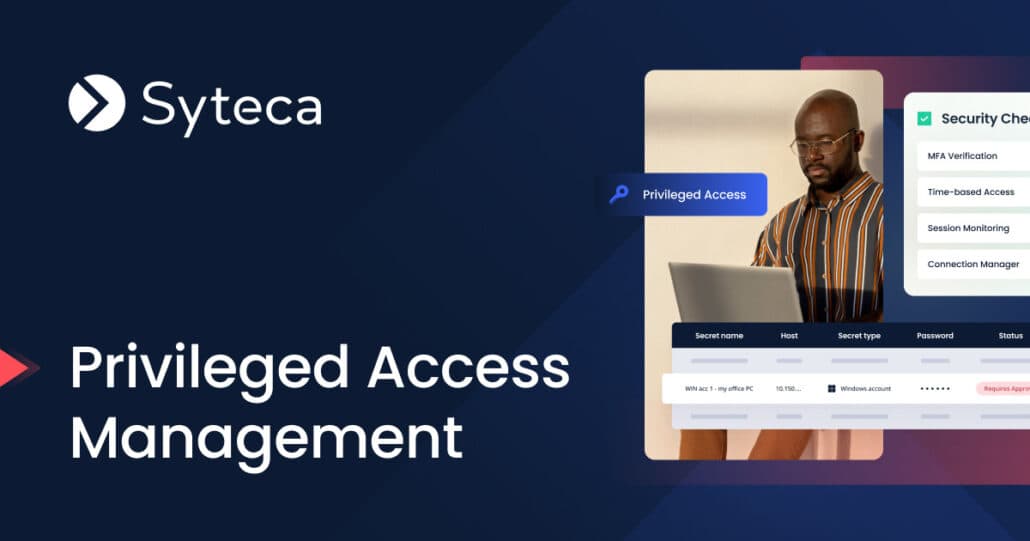
Syteca’s privileged access management approaches enterprise access security from a visibility-first perspective.
A lot of PAM platforms still focus heavily on authentication controls and credential storage. Syteca pushes much further into session intelligence and identity-aware monitoring across privileged environments.
The platform combines PAM and integrated identity threat detection capabilities directly inside the same operational workflow, allowing security teams to monitor administrative activity continuously instead of reviewing isolated events afterward.
Core functionality includes:
- Credential vaulting
- Session recording
- Real-time alerts
- Continuous session validation
- Automated response actions
- Session blocking
- Privileged elevation management
- Multi-factor authentication
- Secure vendor access workflows
- Just-in-time access provisioning
One of the platform’s strongest areas is operational context.
Instead of simply confirming whether access was approved, Syteca helps organizations understand how privileged sessions behave once users enter sensitive systems. That visibility becomes especially valuable across a hybrid infrastructure where administrators, vendors, and contractors move between cloud environments, remote endpoints, and internal systems constantly.
Another important advantage is deployment flexibility.
Many enterprises already operate fragmented infrastructure environments with overlapping cloud and on-premises systems. Syteca supports cloud, hybrid, and fully on-premises deployments without introducing large operational overhead or infrastructure-heavy onboarding models.
That flexibility allows organizations to improve privileged visibility gradually while maintaining centralized oversight across distributed environments.
3. CyberArk
CyberArk remains deeply associated with enterprise-scale privileged access security because the platform has evolved far beyond traditional PAM functionality over time.
Large organizations frequently evaluate CyberArk when privileged access security intersects heavily with governance initiatives, compliance requirements, and enterprise identity programs.
The platform includes:
- Credential vaulting
- Privileged session management
- Endpoint privilege controls
- Secure remote access
- Secrets management
- Identity security integrations
CyberArk often operates less like a standalone PAM product and more like a broad identity security ecosystem supporting large-scale enterprise governance strategies.
Its integration capabilities help organizations centralize oversight around privileged workflows spanning internal systems, cloud environments, and remote administrative infrastructure simultaneously.
The platform also supports operational visibility into administrative activity, helping security teams maintain stronger governance around sensitive privileged operations across distributed enterprise environments.
4. One Identity

One Identity approaches enterprise access security through governance alignment and centralized identity visibility.
The platform connects privileged access controls with policy management, analytics, and governance workflows designed to improve operational consistency around administrative activity.
Capabilities include:
- Privileged password management
- Session monitoring
- Access analytics
- Identity governance integrations
- Policy enforcement
- Secure access workflows
Organizations already operating mature IAM environments frequently evaluate One Identity because the platform aligns PAM functionality closely with broader identity governance strategy.
That alignment becomes increasingly valuable as enterprises manage administrative activity across fragmented cloud infrastructure, internal systems, and distributed remote workflows simultaneously.
The platform’s governance orientation also helps organizations strengthen oversight around privilege assignment, policy enforcement, and identity-related operational risks across complex enterprise environments.
5. Delinea
Delinea focuses strongly on simplifying privileged access security while expanding visibility into administrative workflows and governance controls.
A lot of enterprises struggle because access governance becomes operationally difficult to maintain once infrastructure complexity grows across cloud systems, vendors, remote teams, and hybrid environments.
Delinea attempts to reduce that friction.
The platform combines privileged access controls with behavioral analytics and governance visibility designed to improve operational oversight without creating excessively fragmented administrative environments.
Core functionality includes:
- Credential vaulting
- Session management
- Behavioral analytics
- Least privilege controls
- Access governance
- Application access security
Delinea is frequently evaluated by organizations trying to strengthen administrative visibility while maintaining manageable deployment and operational workflows internally.
Its behavioral analytics capabilities also help enterprises identify unusual privileged activity patterns across distributed environments where manual oversight becomes increasingly difficult.
Access security became more about oversight than authentication
A lot of enterprise security discussions still focus heavily on authentication controls.
Those controls matter, obviously.
But many organizations now realize the bigger challenge starts after access is already granted. Security teams increasingly need visibility into how privileged identities behave operationally across the environment itself.
That includes:
- Session activity
- Privilege escalation
- Remote administrative workflows
- Vendor access behavior
- Endpoint-level permissions
- Access governance consistency
Static credential protection alone no longer provides enough operational context once privileged activity spreads across distributed infrastructure environments.
Enterprises increasingly care about reducing uncertainty
One reason modern PAM platforms continue evolving is that enterprises want fewer blind spots around privileged activity.
Security teams do not simply want confirmation that credentials remain protected.
They want to understand:
- Which systems users accessed
- How privileges changed over time
- Whether administrative behavior looks normal
- Which vendors still retain access
- How remote workflows operate operationally
The strongest PAM vendors increasingly compete around that operational visibility instead of pure credential management functionality alone.
Modern PAM vendors are influencing broader enterprise governance strategy
PAM platforms now sit much closer to enterprise governance and operational security workflows than they did previously.
Organizations increasingly depend on these platforms to improve administrative visibility, reduce privilege sprawl, centralize oversight around sensitive systems, and strengthen identity-related governance controls across distributed infrastructure.
That shift explains why session intelligence, governance visibility, and behavioral monitoring continue becoming major priorities across the PAM market.
Syteca stands out especially well in this category because the platform combines privileged access management and integrated identity threat detection through continuous session intelligence and behavioral visibility workflows.
For many enterprises today, access security is no longer simply about verifying identities.
It is about reducing uncertainty around privileged activity itself.