
Enterprise software delivery has entered a strange phase. Engineering organizations have more tooling than ever before, yet many teams feel less operationally efficient than they did a few years ago. Every stage of the SDLC became heavier.
Requirements systems expanded across multiple platforms. Architecture governance introduced additional review layers. QA environments multiplied as release frequency increased. DevOps operations became deeply interconnected with cloud infrastructure, security controls, observability tooling, and compliance workflows.
Most enterprises responded by adding more automation. But automation alone did not solve coordination problems. Now, AI is entering the picture differently.
Not as another isolated engineering tool, but as a connective layer between software delivery functions that historically operated with limited continuity between them. That distinction matters much more than people expected.
The companies getting attention right now are usually not the ones focused only on development acceleration. They are the providers helping enterprises rebuild software delivery coordination around AI-assisted operational workflows.
Here are five companies that enterprises increasingly evaluate as AI-enhanced SDLC modernization becomes a larger engineering priority.
1. Avenga

Avenga AI-driven software development services position AI much less like an isolated engineering assistant and much more like an operational layer integrated throughout the SDLC.
That changes the conversation entirely.
Many organizations already have developers using copilots independently. But disconnected experimentation rarely improves the software delivery systemically. It often creates fragmented workflows, inconsistent governance models, and uneven operational visibility between engineering teams.
Avenga’s approach focuses heavily on orchestration across delivery operations instead.
The company embeds AI into:
- Planning and estimation
- Requirements engineering
- UX and design workflows
- Architecture analysis
- QA coordination
- DevSecOps operations
- Incident management
- Engineering execution
One especially notable aspect is how strongly the model centers around workflow continuity.
Architecture systems become easier to maintain because AI continuously analyzes delivery environments instead of relying entirely on manual reviews. QA operations become more adaptive because testing scenarios evolve directly from requirements and the delivery context. Incident response gains operational memory through contextual AI assistance connected to historical system activity.
Another differentiator is role-specific AI integration. Instead of treating engineering organizations like one generic workflow, Avenga structures AI environments around operational delivery functions individually. Architects, QA specialists, developers, product teams, and infrastructure operations all work with AI systems aligned to their own responsibilities.
That creates significantly more coordination across software delivery environments overall. The company also combines AI-native SDLC modernization with broader expertise involving enterprise product engineering, cloud infrastructure transformation, operational scalability, and governance-heavy delivery ecosystems.
2. Itransition
Itransition focuses heavily on enterprise software engineering and operational transformation projects involving AI-supported delivery systems.
The company works with organizations integrating AI capabilities into larger SDLC ecosystems requiring scalable infrastructure and engineering coordination.
Capabilities include:
- AI-assisted software engineering
- Enterprise platform modernization
- Workflow automation
- QA optimization
- Cloud engineering
- DevOps support
Itransition is especially relevant for organizations operationalizing AI within existing engineering systems rather than replacing delivery environments entirely.
A major advantage is architectural flexibility. Enterprise SDLC transformation usually requires coordination across APIs, testing operations, governance systems, infrastructure layers, and distributed engineering environments simultaneously. Itransition’s broader engineering background helps support those implementation ecosystems effectively.
3. SoftServe
SoftServe has invested heavily in AI-enhanced engineering modernization and operational transformation initiatives involving large enterprise delivery ecosystems.
The company supports organizations embedding AI into software delivery operations involving analytics systems, distributed engineering teams, enterprise applications, and cloud-native infrastructure.
Capabilities include:
- AI-driven engineering modernization
- Enterprise AI implementation
- Workflow optimization
- QA automation
- Cloud-native delivery systems
- Data and analytics engineering
SoftServe is especially relevant for enterprises where engineering complexity already spans multiple operational environments simultaneously. One noticeable advantage is the transformation scale.
AI-enhanced SDLC initiatives often become difficult operationally once implementation expands across governance systems, engineering squads, infrastructure environments, testing workflows, and security operations all at once. SoftServe supports those broader transformation ecosystems effectively.
4. N-iX
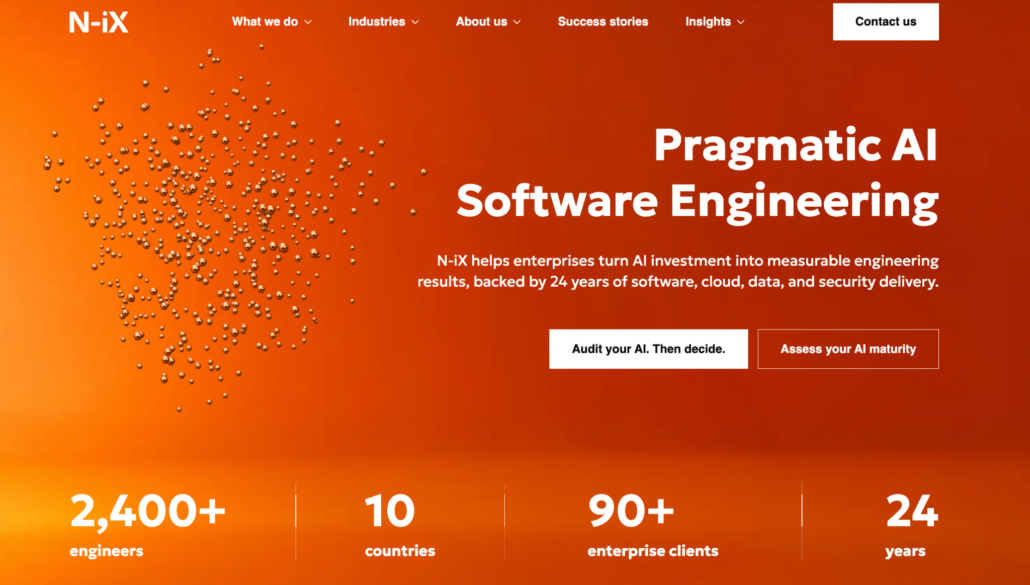
N-iX has expanded its AI engineering capabilities significantly across enterprise modernization and AI-enhanced delivery operations.
The company works with organizations integrating AI into distributed engineering environments and cloud-native software ecosystems where delivery coordination increasingly depends on infrastructure visibility and workflow synchronization.
Capabilities include:
- AI engineering
- Workflow automation
- SDLC modernization
- Cloud-native delivery systems
- Enterprise product development
- Data engineering
N-iX is especially relevant for organizations operationalizing AI across engineering ecosystems rather than isolated development environments. One area where the company stands out is infrastructure coordination.
Modern software delivery environments depend heavily on synchronization between DevOps systems, testing operations, CI/CD pipelines, governance workflows, and cloud infrastructure layers simultaneously. N-iX supports those implementation ecosystems particularly well.
5. Intellias
Intellias has expanded its AI engineering capabilities significantly across enterprise product engineering and operational modernization environments.
The company supports organizations embedding AI systems into distributed software delivery operations involving cloud-native infrastructure and enterprise-scale engineering ecosystems.
Capabilities include:
- AI-assisted engineering
- Product delivery optimization
- Workflow automation
- Enterprise platform engineering
- Cloud-native systems
- Data infrastructure
Intellias is especially relevant for enterprises trying to modernize engineering coordination across large operational environments.
One important strength is systems integration. AI-enhanced SDLC environments eventually need architecture governance, QA systems, DevOps workflows, infrastructure operations, and engineering platforms to interact with significantly more continuity than before. Intellias supports those integration-heavy ecosystems effectively.
AI adoption is becoming more operational
One of the biggest changes happening right now is where enterprises expect AI to create value.
Initially, most organizations focused on developer productivity alone. Now the focus is shifting toward delivery coordination across the SDLC itself.
Engineering teams want better continuity between requirements, architecture, testing, infrastructure, deployment operations, and incident response. They want fewer disconnects between delivery stages. They want operational visibility across increasingly distributed engineering ecosystems.
That is where AI-enhanced SDLC models are becoming especially valuable. The strongest implementations are usually not the ones with the most AI tools. They are the ones where AI improves workflow continuity across software delivery operations overall.
And that shift is becoming much more important than standalone coding acceleration alone.