
For an early-stage startup, the mobile app is usually the main thing customers interact with. It’s also often where your first revenue comes from.
Here’s the problem. Founders usually have limited money, tight deadlines, and investors who want to see traction fast. Pick the wrong technical partner in that situation, and it gets expensive.
So in this article, we offer a clear, data-driven guide. We’ll walk you through what startups should look for when vetting development firms. Then we’ll review three experienced companies that focus specifically on early-stage mobile development.
What Startups Should Look for in a Mobile App Development Company
Choosing the right mobile app development company is one of the most important decisions a startup makes. It’s not just about coding — the right partner helps shape your product and build a strong foundation for growth.
Here’s what actually matters:
- Startup experience. You want a partner who gets fast pivots, tight budgets, and the way accelerator-backed startups operate.
- Technical skills. They should be strong in native development — Swift and Kotlin. Also cross-platform with React Native or Flutter. And if they have AI or IoT knowledge? That’s a nice plus.
- Full-cycle support. This means they handle everything from discovery and design to development, testing, and maintenance. No gaps.
- Security and scalability. Look for certifications like ISO 27001. Also make sure they have cloud and compliance expertise.
- Communication and culture. You need clear updates, an agile process, and on-time delivery. Plus a working style that actually fits with yours.
Companies Providing Mobile App Development for Startups
You know a great app can make or break your startup. But not every development company actually gets how startups work.
You need speed, sure. But you also don’t want to rebuild everything six months later.
The firms below have solid track records with early-stage companies. Some also work with large enterprises — which means they can scale when you do.
Geniusee
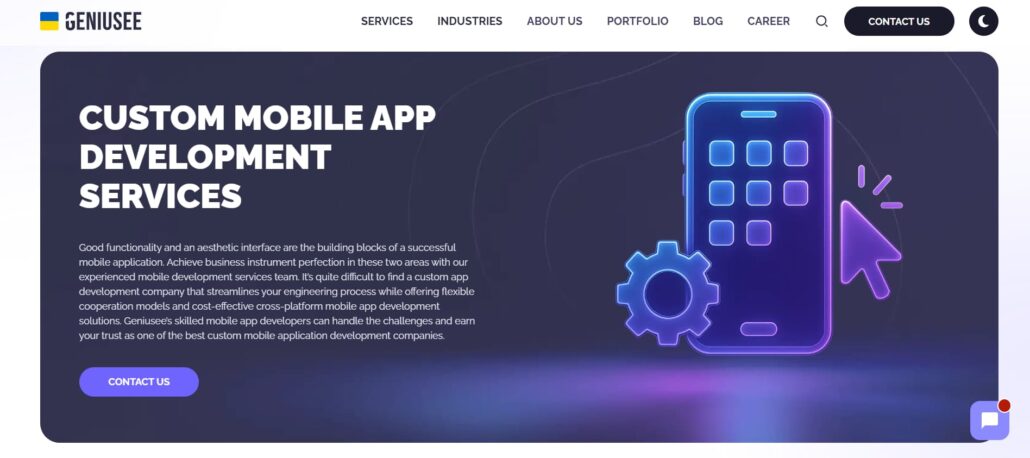
Geniusee mobile app development company was launched in 2017. Fast forward to today, and they have over 300 people and 180+ mobile projects delivered. Their focus is on FinTech, EdTech, Retail, Manufacturing, and Real Estate.
What gives them an edge? A few things:
- AWS Advanced Tier Service Partner;
- ISTQB Platinum Partner;
- ISO 9001 and ISO 27001 compliant.
That combination of deep expertise and actual certifications matters. It means they can handle fast-moving startups—including Y Combinator–backed ones—and also large enterprises that need secure, scalable systems.
On the tech side, Geniusee builds AI, 5G, and IoT features directly into mobile apps. But they’re not just a vendor. They partner with you from the very first idea all the way through to what happens after launch.
For enterprise clients, the dual certifications in quality and security are a big deal. It means their mobile initiatives are built on solid process control and strong data protection. That’s why highly regulated industries trust them.
Core mobile services:
- Native iOS and Android (Swift, Objective-C, Kotlin, Java);
- Cross-platform with React Native (one codebase, faster delivery);
- AI, 5G, and IoT integration (adaptive interfaces, real-time data from sensors and wearables);
- Legacy mobile upgrades (moving old code to SwiftUI or Jetpack Compose, sometimes adding AI).
Atomic Object
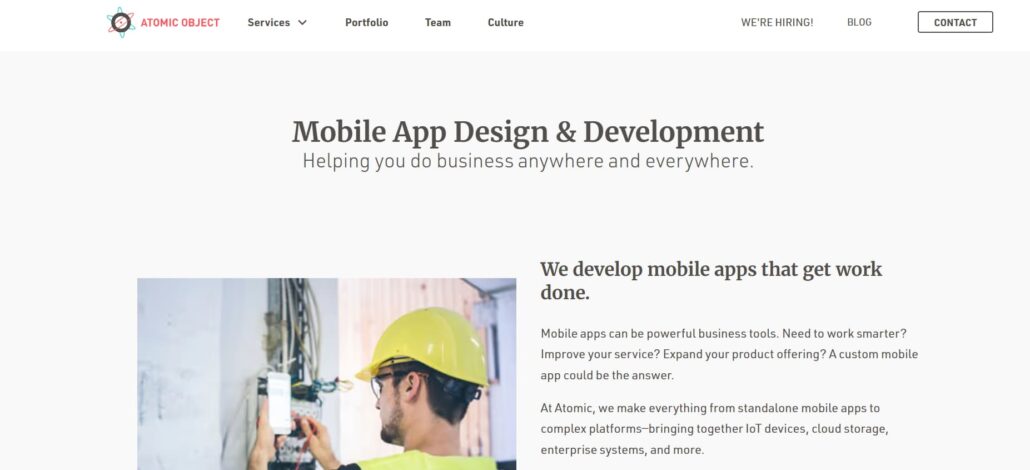
Atomic Object builds custom mobile apps, but here’s the thing—they’re really focused on your return on investment. For them, that means creating software that’s not just easy to use but also built to last. And they actually deliver on time and within budget.
A lot of development firms rush to get something out the door. Atomic takes a different route. They build adaptable, maintainable solutions, whether it’s:
- A simple consumer app;
- A complex platform that ties together IoT devices;
- Systems that connect cloud storage with older enterprise software.
What really stands out? Their process is deeply collaborative. Clients stay involved at every stage, so the final product doesn’t just handle today’s problems. It’s also solid enough to grow and evolve as technology keeps moving forward.
Appinventiv
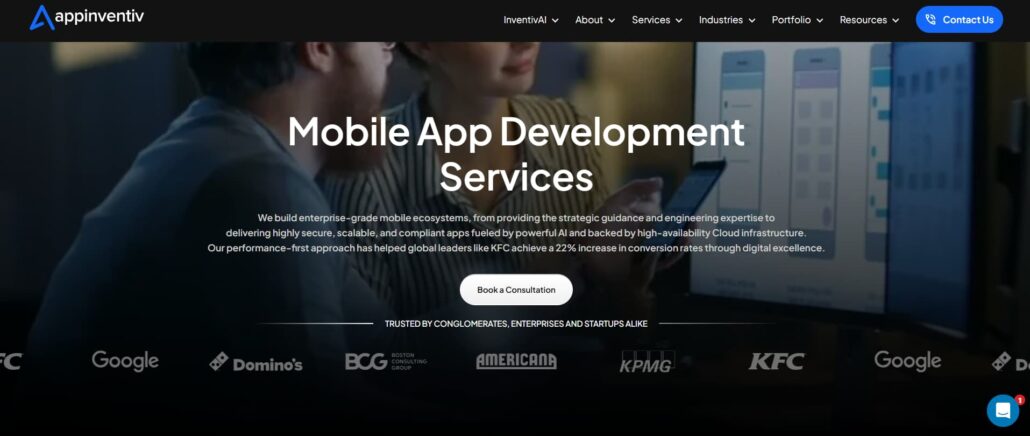
Appinventiv launched in 2015. Since then, it’s grown into a full-cycle mobile app development company that works with both startups and large enterprises.
Their focus is on building digital products for iOS and Android. But here’s the thing — they’re not just trying to make things functional. They want to build products that actually move the needle for your business.
They specialize in a few key sectors: healthcare, fintech, retail, and logistics. And they offer complete end-to-end support. Here’s a breakdown of what that includes:
- Native iOS and Android development for strong performance and deep device integration;
- Cross-platform development using Flutter and React Native — so one codebase works on both platforms;
- UI/UX design built around intuitive, engaging interfaces that users actually like;
- Enterprise mobile apps for internal business systems;
- Comprehensive testing and QA across fragmented devices;
- Ongoing maintenance, updates, and feature improvements after launch.
So in short, they make sure your mobile solution isn’t an afterthought. It becomes a core part of how your business actually runs day to day.
How the Right Development Partner Helps Startups Grow
So how does the right development partner actually help your startup grow? It’s not just about writing code. A good partner builds products that work well today and can scale later.
Here’s what they typically deliver:
- Quicker market entry. They use cross-platform development and modern tools to help you launch faster and stay ahead.
- Less technical debt. By picking solid architectures from the start, your app stays easy to maintain as it grows.
- Higher user retention. Features like personalization and smart recommendations keep people coming back.
- Smooth integrations. Reliable connections to your ERP, CRM, IoT, or other systems — so data flows cleanly and securely.
- Better fundraising potential. A mature, secure, well-designed app gives investors confidence. It makes your startup look more polished and professional.
Tips for Choosing a Mobile Development Partner
Even with a solid shortlist, picking the final partner requires careful evaluation. Use these practical tips to make the right choice for your startup:
1. Check Startup-Specific References
Don’t just read testimonials—ask for direct contact with 2–3 past startup clients. Ask those founders: Did they deliver on time? How did they handle changing requirements? Would they hire them again?
2. Audit Their Discovery Process
A good partner won’t write a single line of code before understanding your problem. Ask to see their product discovery framework. If they can’t clearly explain how they validate assumptions and define MVP scope, walk away.
3. Demand a Small, Committed Team
Big agencies often swap developers mid-project. Insist on knowing exactly who will work on your app day-to-day. Better yet, ask for a dedicated team of 3–5 people who stay with you from kickoff to launch.
4. Test Their Response to “We Need to Pivot”
Now test them on pivots. Startups change direction fast. So during interviews, give them a scenario where your core features shift by 30%. Then watch how they react.
- Good partner: talks agile adjustments.
- Bad partner: panics or brings up change orders.
That’s the difference.
5. Verify IP and Exit Protections
Your code is your asset. Ensure the contract gives you full IP ownership, access to all repositories, and a clear transition plan if you part ways. Never accept “vendor lock-in” clauses.
6. Start with a Small Paid Pilot
Before signing a six-figure deal, pay for a 2–4 week sprint to build a non-critical feature. This reveals their real communication style, code quality, and project management—without the risk.
7. Align on Success Metrics, Not Just Features
The best partners ask: What does success look like for your business? They should track retention, crash rates, and launch timelines—not just completed tasks.
Conclusion
So here’s the bottom line. Choosing a mobile app development company isn’t a small decision. It affects whether you launch on time, scale without major issues, and bring in investment.
A lot of firms offer development services. But startups need more than that. Look for partners who have real experience with early-stage ventures, plus modern technical skills and full-cycle support.
From there, match each option against your own technical needs, budget, and growth plan. Do that carefully, and you’ll put your product in a much better position for long-term success.